


SUSy Stereotactic Ultralight System
Experience Versatility and Innovation.
The next generation of frame-based stereotaxy. Carbon fibre reinforced PEEK. Under 2 kg. Precision in the µ range. MRI and CT compatible.
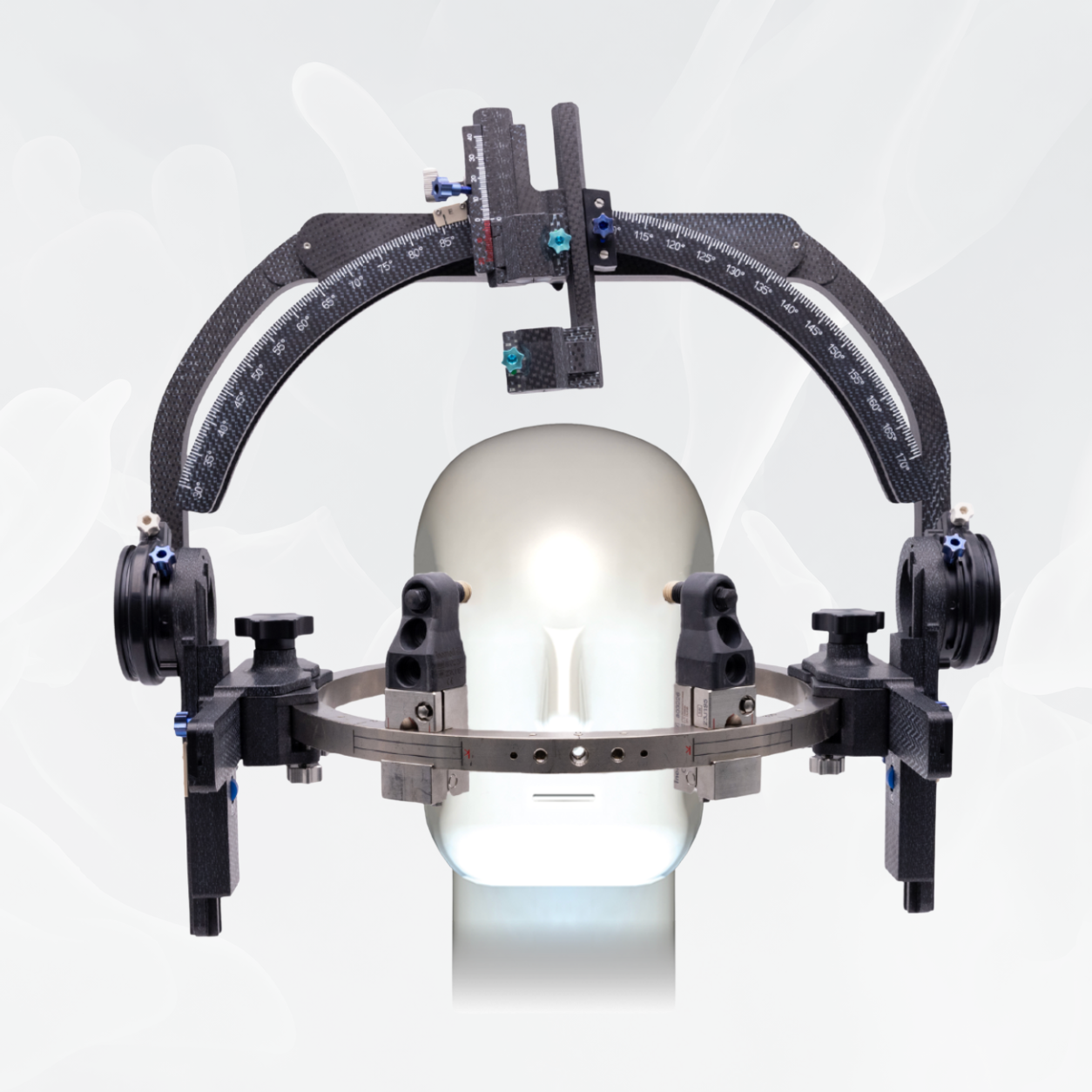
< 2 kg
System Weight
0.1 mm
Vernier Precision
190 mm
Working Length
5 steps
Structured Workflow
Relevant application fields

Functional Neurosurgery
Functional neurosurgery is a specialised branch of neurosurgery that focuses on the diagnosis and treatment of diseases of the central and peripheral nervous system that significantly impair…
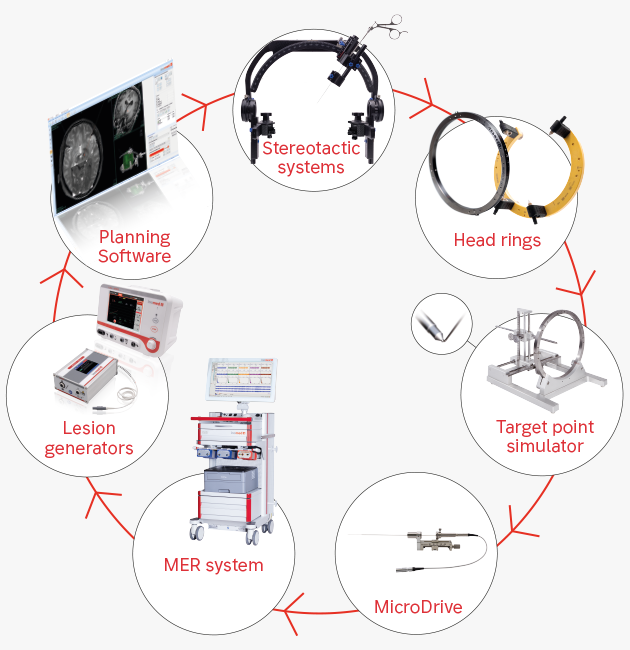
SUSy - The Complete Stereotactic Workflow
A structured 5-step system covering every phase of stereotactic neurosurgery — from fixation and localisation through review, arc positioning, and clinical application.
- Step 1 - Fixation: Stereotactic ring applied to the patient's head. Choice of titanium ring (CT standard) or ceramic ring (MRI, open face). Positioning aid allows single-person ring mounting with precise adjustment screws.
- Step 2 - Localisation: Localisation set attached to the ring for preoperative imaging. Four plates ensure maximum precision in image registration (individually removable). Universal for CT and MRI — no need to refill plates.
- Step 3 - Review: Target Point Simulator verifies coordinates and trajectories on the skull prior to surgery. Patient-specific validation, identifies inaccurate instruments, used for training and self-control. Autoclavable.
- Step 4 - Stereotactic Arc: SUSy CF-PEEK arc mounted to the ring. 0.1 mm Vernier precision, Cartesian coordinates + angles, crosshairs for intraoperative control, Drumstop mechanism, no mounting tool needed.
- Step 5 - Application: Supports DBS electrode implantation, MER, RF thermolesion, sEEG depth electrode placement, stereotactic biopsy, brachytherapy, and catheter placement. Full inomed accessory ecosystem.
Benefits
Ultralight
Under 2 kg for Effortless Handling
The CF-PEEK arc’s weight of less than 2 kg significantly reduces physical burden on the patient and surgical team, and increases handling precision compared to heavier stainless steel systems.
MRI Workflow
Full MRI Compatibility
Non-metallic PEEK and ceramic ring enable intraoperative and immediate postoperative MRI without artefacts. Opens up MRI-guided stereotactic workflows that metal frames cannot support.
Precision
0.1 mm Vernier Accuracy
The Vernier scale enables setting accuracy of 0.1 mm essential for DBS targeting of sub-millimetre brain nuclei and other demanding stereotactic interventions.
Safety
Target Point Simulator
Pre-surgical verification of coordinates and trajectories on the skull — before any instrument enters the patient. Identifies inaccurate instruments and validates patient-specific target points, reducing intraoperative risk.
Versatility
Full Spectrum Coverage
One system for DBS, sEEG, biopsy, brachytherapy, RF thermolesion, and catheter placement. Eliminates the need for multiple stereotactic platforms across a neurosurgery department.
Patient Comfort
Ceramic Open-Face Ring
The ceramic ring’s open face design maintains airway access for intubation and preserves the patient’s field of vision during awake procedures a significant clinical and patient comfort advantage.
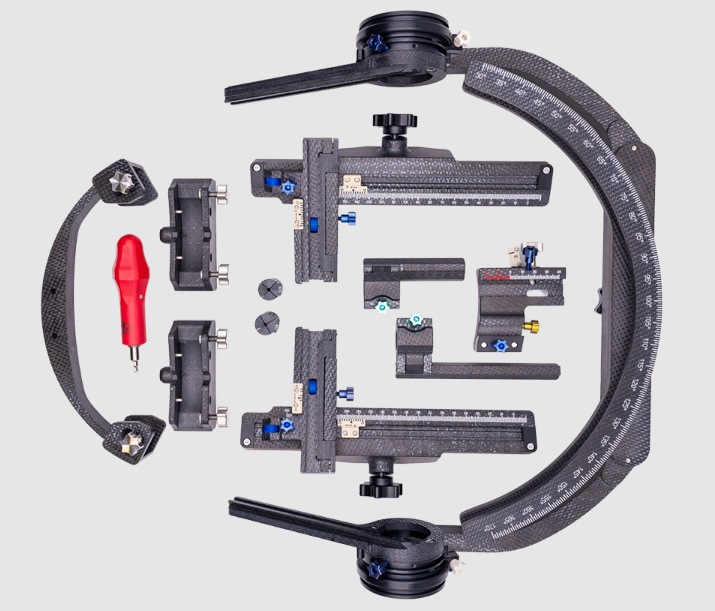
Carbon Fibre Reinforced PEEK — Developed for the Highest Demands
Originally developed for space travel applications. Diamond-milled. Combining the structural performance of carbon fibre with the chemical and biological compatibility of PEEK polymer.
- Ultralight Weight: The weight of less than 2 kg significantly increases handling precision and patient comfort throughout the procedure, including awake DBS procedures.
- MRI Environment Safe: Non-metallic CF-PEEK is fully compatible with the MRI environment. No ferromagnetic components. Opens new possibilities for MRI-based intraoperative workflows.
- CT & X-Ray Transparent: PEEK is artefact-free and transparent for CT and X-ray imaging. Resistant to high temperatures during sterilisation and to X-ray radiation over repeated use.
- Durable & Chemical Resistant: High wear resistance with optimum sliding properties. Resistant to cleaning chemicals. Diamond-milled surface meets the highest stability requirements of any stereotactic system.
Clinical Applications
Versatile in Use. Innovative in Application.
A large portfolio of accessories opens up countless possibilities and universal use in modern stereotaxy across functional, oncological, and diagnostic neurosurgery.
Deep Brain Stimulation (DBS)
Electrodes are implanted in specific brain areas to treat movement disorders with electrical impulses. Target structures are sub-millimetre, requiring the highest precision. The inomed MicroDrive (50 µm resolution) and MER system complete the DBS portfolio.
- DBS electrode implantation
- Microelectrode recording (MER)
- RF thermolesion
- Catheter placement
Stereo-EEG (sEEG)
Stereotactically placed depth electrodes record EEG signals for the diagnosis of drug-resistant epilepsy. Lateral trajectories are preferred; the SUSy’s AP mounting capability enables these trajectories unconditionally and safely — even in the posterior cranial fossa.
- Drug-resistant epilepsy diagnostics
- Lateral trajectory support
- AP mounting for complex trajectories
Stereotactic Biopsy & Brachytherapy
When surgical resection is not safely feasible due to tumour location, stereotactic biopsy provides diagnosis with minimal access. The SUSy’s flexibility also supports stereotactic brachytherapy, with inomed offering a comprehensive range of biopsy instruments.
- Stereotactic biopsy (diagnosis)
- Stereotactic brachytherapy (therapy)
- Posterior cranial fossa trajectories
Every Component Engineered for Precision
The SUSy system is built around five key component groups each designed with rigorous clinical and engineering standards for stereotactic neurosurgery.
Step 1 - Fixation
Stereotactic Ring System
Choice of titanium (CT) or ceramic (MRI) ring. Both offer individual fixing post positioning and high stability. Positioning aid enables single-person mounting with adjustment screws.
- Titanium ring: closed, 4 post lengths, CT standard
- Ceramic ring: open face, absolute MRI artefact freedom
- CFRP posts for ceramic ring are artefact-free MRI/CT
- OptiPins: multiple lengths for all cranium sizes
- Head ring holder: starburst interface, AP mounting
Step 2 - Localisation
Localisation Set
Uncompromising design prevents any movement of the localisation plates. Universal for CT and MRI. Intuitive attachment to the stereotactic ring.
- Four localisation plates for maximum registration precision
- Plates can be removed individually
- User-friendly - no need to refill the plates
- niversal application for CT and MRI sequences
Step 3 - Review
Target Point Simulator
Displays the trajectory on the skull prior to surgical intervention — offering maximum safety. Patient-specific target point validation. Autoclavable for repeated sterile use.
- Pre-surgical trajectory visualisation on skull
- Patient-specific coordinate validation
- Identifies inaccurate instruments before use
- For training, self-control, and intraoperative safety
- Autoclavable
Step 4 - Stereotactic Arc
SUSy CF-PEEK Aiming Arc
The centrepiece of the SUSy system. Combines the strengths of previous inomed arcs with innovations based on clinical opinion. Lightweight, precise, intuitive, and MRI-compatible.
- CF-PEEK diamond-milled, space-grade material
- Under 2 kg total weight
- 0.1 mm Vernier precision; 190 mm working length
- Crosshairs for intraoperative position control
- Drumstop easy surgical field access
- Two-point fixation; maintains sterile barrier
Frequently Asked Questions
Answers for neurosurgeons, neurophysiologists, and procurement teams evaluating the SUSy Stereotactic Ultralight System for their practice.
What is the SUSy Stereotactic Ultralight System?
SUSy stands for Stereotactic Ultralight System. It is a frame-based stereotactic neurosurgery system by inomed Medizintechnik GmbH, distributed in India by VCSmed India. The arc is made of carbon fibre reinforced PEEK and weighs less than 2 kg. The full system covers five workflow stages: fixation, localisation, review, arc application, and intervention and supports DBS, sEEG, biopsy, and brachytherapy.
Is the SUSy Stereotactic frame MRI Compatible?
Yes. The SUSy system uses carbon fibre reinforced PEEK, a non-metallic material for the stereotactic arc, making it suitable for the MRI environment. The ceramic ring option provides absolute freedom from MRI artefacts, and CFRP head fixing posts are specifically developed for artefact-free MRI and CT scans. This makes the SUSy ideal for MRI-based stereotactic workflows.
What is the precision of the SUSy stereotactic arc?
The SUSy arc features a Vernier scale allowing setting accuracy of 0.1 mm described as precision in the micron range. The system uses Cartesian coordinates (a, b, c) and angles (d and e) for trajectory planning, with a working length of 190 mm and four possible mounting positions on the ring for maximum trajectory flexibility.
What procedures can be performed with SUSy system?
SUSy supports: Functional Neurosurgery (DBS electrode implantation, microelectrode recording, RF thermolesion, catheter placement); Stereotactic EEG/sEEG (epilepsy diagnostics with depth electrodes, including lateral and posterior fossa trajectories); and Oncological Neurosurgery (stereotactic biopsy and stereotactic brachytherapy).
What is the difference between the titanium and ceramic ring?
The titanium ring is a closed ring, the standard choice for CT imaging, and offers maximum flexibility through different mounting positions and four head fixing post lengths. The ceramic ring has an open face design for airway access and patient field of vision during awake procedures, and uses ceramic material which guarantees absolute freedom from MRI artefacts. CFRP head fixing posts are required with the ceramic ring for artefact-free imaging.